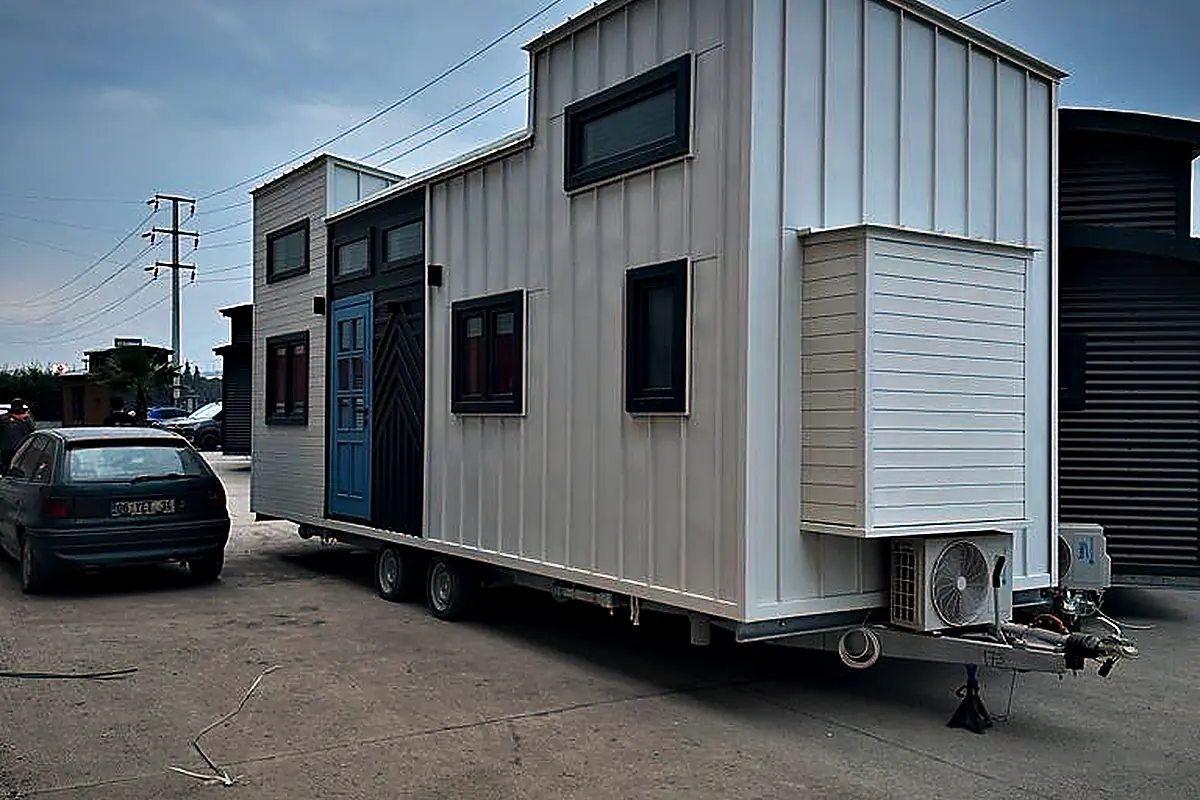
Tiny house for municipalities and tourism boards
When a municipality thinks about tiny houses it is rarely about a house. It is about a site, a development plan, a participation procedure, a procurement — and whether what finally stands there matches what was resolved. For that an administration needs different documents from a private customer.
For municipalities, tourism boards and municipal companies MODUNERA supplies what a project needs in the administration: technical product documents for land-use planning and procurement, dimensions, weights and connection requirements per model, information on placement without a foundation and on removal, and delivery of several units as one planned project. Land-use planning, participation and procurement remain the municipality's; we monitor current procedures and name them with their source.
Pilot site, settlement or tourism offer: three different projects
Municipal tiny-house projects usually take one of three forms. A pilot site where a few units stand for a limited time to gather experience. A settlement for which a development plan is drawn up or amended and in which units are lived in permanently. Or a tourism offer — overnight units by a lake, on a municipal campsite, along a hiking trail — operated by a tourism board or a municipal company.
The three need different documents and different schedules. A pilot site can stand within a season; a settlement needs the land-use planning procedure with participation; a tourism offer needs an operator and a calculation in nights. We first ask which project is meant.
Documents for land-use planning and procurement
An administration preparing a project needs information that can be carried into a development plan, a council paper or a specification: dimensions per model, weights, footprint, height, placement on supports without a foundation, connection requirements for power, water and wastewater, removability. We supply this as technical product documents.
What we do not supply is the planning itself. Land-use planning, environmental assessment, participation and procurement are tasks of the municipality and its planners; we do not replace legal, planning or procurement advice. The documents are written so that they fit into those procedures.
Current procedures, with source and check date
We monitor current municipal procedures on tiny-house sites in Germany and its neighbours — participation procedures, development plans, tenders — and publish them on the news page with the official source and the date we last checked them. A figure the source does not give, we do not give.
For a municipality preparing its own project these procedures are references: how other municipalities designated the site, ran the participation and regulated the use. The page links to the original documents, not to our summary.
Several units, one schedule, one contact
A municipal project rarely delivers one house. It delivers five or twenty, to a site prepared for it, in a window the resolution sets. Delivery is planned as one job: route, access, placement sequence, connection. The way from production is by road, with a Ro-Ro or ferry leg depending on the destination; the 2.55 m base width of all models keeps transport possible without oversize.
For the administration that means one contact for all units, one schedule and one set of documents — and the option of relocating or removing the units later, because they stand on supports and not on foundations.
Clarify before enquiring
- Which project is meant: pilot site, settlement or tourism offer
- Stage of the procedure: resolution, land-use planning, participation, procurement
- Site, ownership and what is permitted there under planning law
- Services to the site: power, water, wastewater, access
- Who operates the units and over what period
- Number of units and the window the resolution sets
Further reading in the existing guides:
Fast answers, clear limits.
Enquire and name the procedure. Whether and how participation is possible depends on the specification, the suitability requirements and the deadlines. The technical product documents an administration needs for it, we supply.
No. Land-use planning, environmental assessment, participation and procurement are tasks of the municipality and its planners. We supply the technical information on the house that can be carried into those procedures and do not replace legal, planning or procurement advice.
Yes. The units stand on four supports without a foundation and are transported by road. Relocation and removal are therefore transport operations, not demolition — which for pilot sites and time-limited uses is often the decisive point.
From official sources: participation portals, council information systems, official gazettes. Each entry names the source and the date of the last check. A figure the source does not give is not there.
We name completed projects only when they are documented and the client agrees. Ask for them in the enquiry; what we cannot evidence, we do not claim.
Other operator types
Campsite & glamping
Rental units that fit the site rules and arrive outside the season.
Units in seriesHoliday park & resort
Identical units in series, calculated against operator rules and running costs.
Rooms outside the houseHotel & nature hotel
Extra rooms in the grounds that match the house and arrive outside the season.
Overnight stays by the waterMarina & coast
Overnight units by the water, specified for salt, wind and damp.
Permanently lived-in unitsTiny-house village & eco-village
Permanently lived-in units for settlements, villages and community projects.