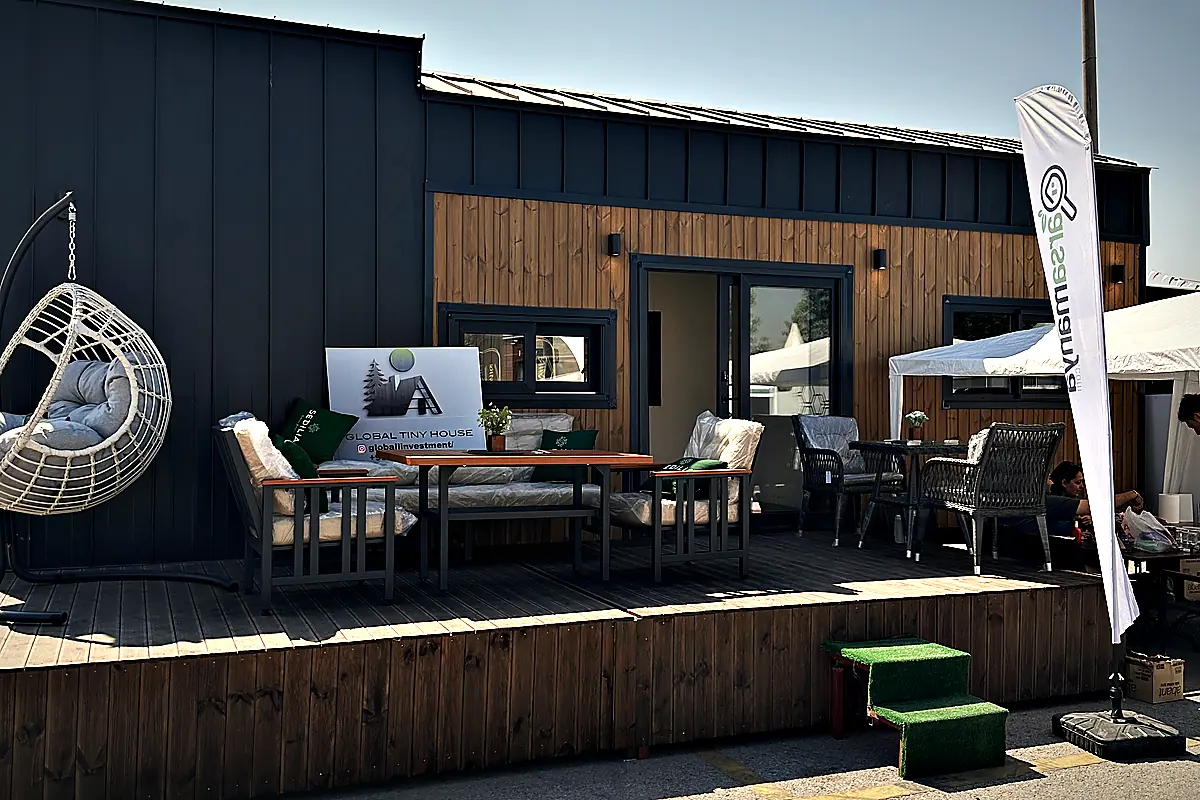
Tiny house for holiday parks and resorts
A holiday park does not buy a house, it buys a series. Twelve identical units cleaned on the same day, repaired with the same spare parts and let under the same rules. What is a preference with one house becomes an operating-cost question with twelve.
For holiday parks and resorts MODUNERA plans tiny houses as a series of identical units, or units graded in a few variants: a layout that cleans quickly, materials that stand up to guest use, connections designed for the park's infrastructure, and a delivery that fits the park's operating year. Operator rules, running costs and the park's permit remain the operator's.
Why a series is different from twelve single orders
A park running twelve units needs them identical — not for design reasons, but because cleaning, maintenance, spare parts and the booking system rely on sameness. A tap that is the same in eleven houses and different in the twelfth costs more in operation than it saved at purchase.
So a series project with us is drawn once and then built: one layout, one specification list, one facade variant, possibly a second variant for families. Changes are decided before the series, not during it. That is the difference between a park and twelve private customers.
Operator rules and running costs are part of the calculation
Many holiday parks let pitches to investors and operate the units themselves. Then operator rules apply: which units are admitted, what they may look like, which running costs arise and how they are indexed. Those rules are fixed before the purchase and belong in the calculation before a model is chosen.
We ask for these rules and plan the house against them: permitted dimensions, facade, terrace, connection points. The holiday-park guide goes through the cost side in detail — season, running costs, maintenance and which of them decide the return.
Standardised access, standardised unloading
In a park with fixed roads and fixed pitches the placement repeats. That is an advantage if the first unit was planned carefully: access, crane or manoeuvring position, levelling on the supports, connection points — set once, repeated eleven times.
Delivery is planned to fall in the park's closure or off-season. The way from production is by road, with a Ro-Ro or ferry leg depending on the route; the 2.55 m base width of all models keeps transport possible without oversize.
Materials that stand up to guest use
A unit lived in by changing guests twenty weeks a year ages differently from a home. Doors are slammed more often, floors mopped more often, kitchens used by people who do not know them. The choice of materials follows: worktops of solid panel rather than coated chipboard, lacquered fronts, floors of a high use class.
The twelve components a unit is built from — steel structure, chassis, facade, windows, electrics, kitchen — are on the quality page with their reasoning. For a park what matters most is what proves itself in operation and what can be replaced.
Clarify before enquiring
- The park's operator rules: admitted units, dimensions, facade, terrace
- Running costs per pitch and how they are indexed
- Whether the units are operated by the park or by investors
- Infrastructure per pitch and the connection points
- Closure or off-season as the delivery window
- Number of units wanted and the number of variants
Further reading in the existing guides:
Fast answers, clear limits.
Yes, that is the normal case in a series project. Layout, specification and facade are fixed once and then repeated. A second variant — say with an extra room for families — is decided before the series.
That depends on the number of units, production and the route, and is scheduled in the quotation. It is planned so that placement falls in the closure or off-season.
The operator. We plan the unit so both are quick — and supply the documents with which spare parts can be identified. We do not offer an on-site operating or maintenance service.
Then the park's operator rules apply to the unit, and the running costs belong in the investor's calculation. Both are clarified with the park before ordering; we plan the house against those rules.
Ex-works price indications apply per unit and are on the model pages. How a series project is priced depends on number, specification, route and schedule and is shown in the quotation — not as a flat rate in advance.
Other operator types
Campsite & glamping
Rental units that fit the site rules and arrive outside the season.
Rooms outside the houseHotel & nature hotel
Extra rooms in the grounds that match the house and arrive outside the season.
Overnight stays by the waterMarina & coast
Overnight units by the water, specified for salt, wind and damp.
Municipal projectsMunicipality & tourism
Pilot sites, participation procedures and tenders with the documents an administration needs.
Permanently lived-in unitsTiny-house village & eco-village
Permanently lived-in units for settlements, villages and community projects.