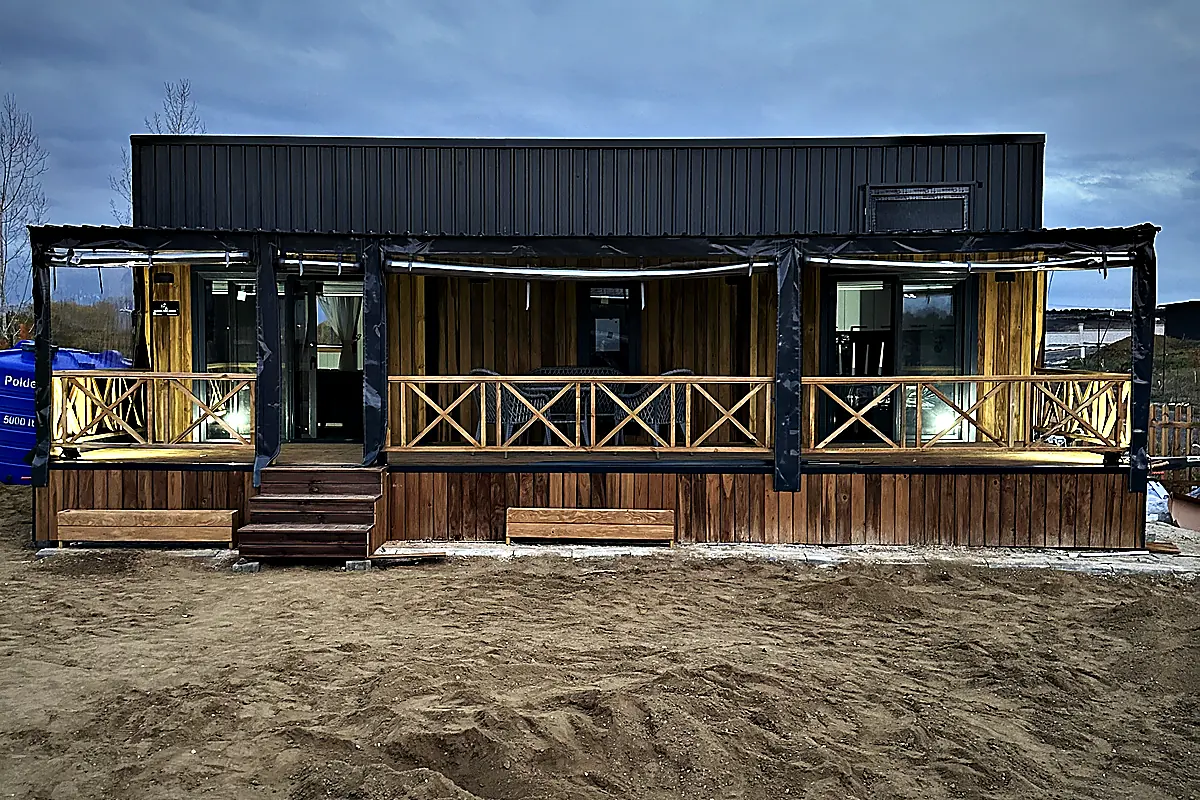
Tiny house for marinas and the coast
A yacht harbour has guests who do not want to sleep aboard in the evening, and areas by the water that stand empty outside the season. A tiny house on the quay is an overnight unit for that — but one that has to withstand salt air, wind and damp, every day.
For marinas, yacht harbours and coastal operators MODUNERA plans tiny houses as overnight units by the water: facade, fittings and glazing chosen for salt air, wind and damp, connections designed for the harbour infrastructure, delivery outside the season. What may be placed on the harbour area is for the operator to settle with the authority and the owner of the land.
Salt, wind and damp decide material and fittings
A unit fifty metres from the water ages faster than one inland if it was not chosen for it. Salt air attacks metal, wind drives rain into every joint, and damp finds the coldest corner. That is not a question of care but of selection: which facade, which fittings, which glazing, which drainage.
For coastal sites we choose the facade variant and the fittings accordingly and ventilate and drain the structure so that damp does not linger. Which glazing is fitted is decided by the climate at the site — on the North Sea the requirement differs from the Valais, and that is how the quality page states it.
Harbour infrastructure: power, water and the wastewater question
A harbour has power pedestals and water points for boats, but rarely a wastewater connection at every area. What exists determines which technology makes sense in the house: fuse rating of the power supply, water heating, whether a kitchen with a hob or only a tea kitchen is wanted.
We design electrics, water and wastewater for the infrastructure the harbour has and say in advance what that means. Where there is no wastewater connection, that is a planning question for the operator, not one a house solves on its own.
What may stand on the harbour area
Harbour areas are often special-use zones, part of a development plan or owned by a Land, a municipality or an association. Whether an overnight unit may be placed there, for how long and at what size is a question for the authority and the owner of the land — not for the manufacturer.
We supply the technical information on the house needed for that clarification: dimensions, weight, placement on supports without a foundation, connection requirements. We do not replace legal or permit advice.
Delivery by road, even when the destination is on the water
A unit for a harbour arrives by road, not by water — even if the way from production includes a Ro-Ro or ferry leg depending on the route. The 2.55 m base width of all models keeps transport possible without oversize. The final access to the harbour grounds, the load-bearing of the quay surfaces and the crane position we check with the operator before ordering.
Delivery is outside the season, when the jetties are empty and a low-loader on the grounds disturbs no one.
Clarify before enquiring
- Who owns the harbour area and what may be placed there
- What the authority permits for the area: duration, size, number of units
- Existing infrastructure: power pedestals and their fuse rating, water, wastewater
- Position relative to the water, wind direction, flood or storm-surge situation
- Low-loader access and load-bearing of the quay surfaces
- Season dates and the delivery window
Further reading in the existing guides:
Fast answers, clear limits.
If facade, fittings, glazing and drainage are chosen for it, yes. That is decided per site, not across the board. Which components it concerns is on the quality page with the reasoning.
That is for the operator, the owner of the land and the authority to settle. Harbour areas are often special-use zones; duration, size and number of units depend on the permit. We supply the technical information on the house for that clarification.
No. The unit stands on four supports that are levelled after setting down; ground and load distribution are part of the planning at the site. On a harbour area that is often the reason placement without a building site is possible.
That is a question of the site and its position, not of the house. Whether an area lies in a flood or storm-surge zone and what is permitted there is for the operator to settle with the authority before a model is chosen.
Delivery is by road to the harbour grounds. Whether a Ro-Ro or ferry leg is part of the route from production depends on the destination; delivery over the quay by ship is not the normal case and is planned only if access and crane require it.
Other operator types
Campsite & glamping
Rental units that fit the site rules and arrive outside the season.
Units in seriesHoliday park & resort
Identical units in series, calculated against operator rules and running costs.
Rooms outside the houseHotel & nature hotel
Extra rooms in the grounds that match the house and arrive outside the season.
Municipal projectsMunicipality & tourism
Pilot sites, participation procedures and tenders with the documents an administration needs.
Permanently lived-in unitsTiny-house village & eco-village
Permanently lived-in units for settlements, villages and community projects.