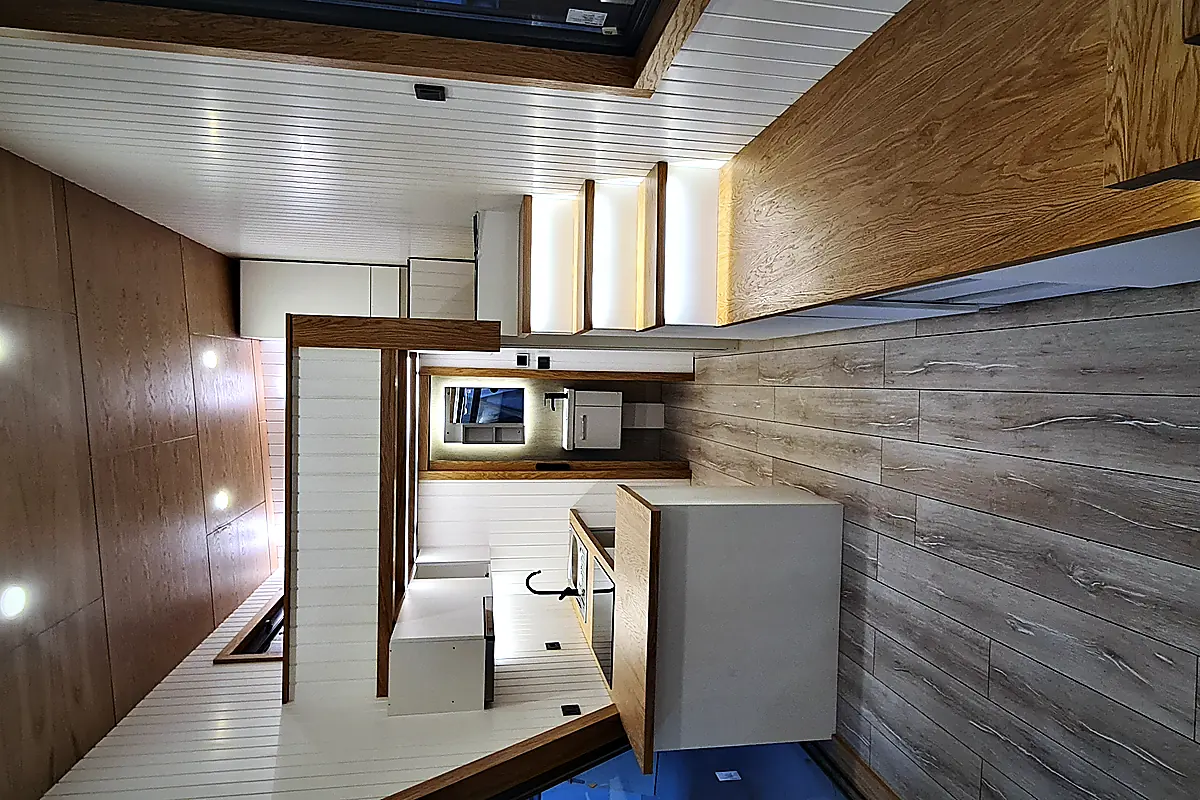
Modular classroom buildings.
Classroom, sanitary and staff modules arranged as a school building. MODUNERA supplies the building concept; school licensing, staffing, furniture standards and operation stay with the operator and the authority.
Project scope, engineering, permissions and delivery are assessed for each destination in Europe and selected African markets. The code MOD-ED is a catalogue reference for enquiries, not a product approval.
Who typically plans this
- Ministries, municipalities and agencies working through a contractor
- NGOs and foundations funding school buildings
- Private schools adding classrooms
Typical use cases
- An 8-classroom block with toilets and a staff room
- Extra classrooms on an existing school site
- A temporary school while a permanent building is built
What is fixed and what is set per project
A row marked MODUNERA reference is a published figure of MODUNERA's units. Every other value is set by engineering for the project and confirmed in the technical offer.
| Parameter | Value | Basis |
|---|---|---|
| Building system | Panelised or volumetric | Set per project |
| Structure | Steel frame | MODUNERA reference |
| Classroom size | Set by the education authority's standard | Set per project |
| Daylight and ventilation | Designed for the climate and the local standard | Set per project |
| Fire, escape and accessibility | To the local code, verified by a local engineer | Set per project |
| Sanitary ratios | By the local standard | Set per project |
Which building system fits which job
Four ways to deliver a modular building. Which one a project uses depends on transport, site access, the number of units and how permanent the building is meant to be — decided in the feasibility step, not here.
| System | Suits | Limits |
|---|---|---|
| Flat-pack modular | Large numbers of identical rooms shipped in compact packs: site offices, dormitories, sanitary units, storage | Assembly on site needs a trained crew; finishes are simpler than a volumetric unit; local approval of the system is a project question |
| Panelised prefabricated | Single-storey houses and buildings with a freer plan: staff housing, rural and serial housing, schools | More site work than volumetric: foundations, panel erection, roofing and finishes on site |
| Modular volumetric | Units fitted out before they leave the hall: hospitality units, homes, clinics and offices where finish quality matters | Transport size and crane access set the limits; fewer units per truck or container |
| Mobile tiny house (MD 1–MD 8) | Single premium units for private living, holiday rental and small hospitality | A mobile unit and a permanent dwelling or hotel room are different permit categories in most countries |
Three scales, as examples
Every figure here is illustrative. A real configuration follows the site, the permit and the operator's programme.
| Scale | Composition | Status |
|---|---|---|
| 8 classrooms | Classrooms, toilets, staff room, store | Illustrative |
| 4 classrooms | Extension block on an existing site | Illustrative |
What we need from you
- Pupils and classrooms
- The education authority's room standard
- Site and existing buildings
- Funding and tender route
- Who furnishes and operates
From brief to installation
Delivery terms (EXW, FCA, FOB, CIF, DAP or other) are agreed per project and per Incoterms edition in the contract. Nothing on this page fixes a delivery term, a price or a lead time.
- BriefYour programme, site, country, quantities and timeline.
- FeasibilityExport, customs, permits, transport and partner questions for the destination.
- Preliminary layoutModule types, counts and a schematic site arrangement.
- ProposalScope, exclusions, delivery terms and the open points.
- Engineering approvalStructure, building physics and services against the applicable local codes, by qualified engineers.
- ProductionBuilt to MODUNERA's specification once drawings and specification are signed off.
- Quality checksInspection points agreed in the contract.
- ShipmentRoad, Ro-Ro or sea freight to the agreed delivery point.
- InstallationBy MODUNERA's team, a local partner or the client's contractor — as the contract sets out.
What a site needs before a unit arrives
- Site with foundations, drainage and safe access
- Power and water connection
- Building permit and approval of the education authority
A modular classroom building is a building. It does not carry any approval to operate a school, and nothing here suggests it does.
Who does what
The same table on every solution page, because the same questions come up in every project.
| Scope line | Responsibility |
|---|---|
| Land procurement | by the client unless contracted |
| Local planning and building permits | local licensed professionals and authorities |
| Foundations and site works | scope dependent |
| Utilities and connections | scope dependent |
| Customs, duties and VAT | destination and contract dependent |
| Transport, unloading and crane | project-specific |
| Installation and warranty | contractual scope dependent |
No datasheet is published for this family yet; technical information is supplied with the offer.
Fast answers, clear limits.
MODUNERA can propose the building. Licensing, staffing, teaching equipment and operation are the operator's responsibility.
Tender participation depends on the tender's eligibility rules and documents. Send the tender reference with your brief.
Quick enquiry — about a minute
Seven fields. A person reads it and replies with the next step; the full project brief can follow.
Our team will review the details and identify the appropriate next technical and commercial discussion. Please keep your reference number for follow-up:
Nothing was saved. Please try again, or write to emre@modunera.com.
Industries and other building types
Prefabricated facilities
MOD-WC · Accommodation for remote project sitesWorkforce camps
Modular accommodation, sanitation, dining and administration concepts structured around workforce capacity, site access and phased delivery.
MOD-PH · Serial single-storey homes for developersPrefabricated houses
Single-storey homes in series — staff housing, rural housing, a first phase of a community — planned around plot sizes, local building rules and the logistics to the site..
MOD-FP · Offices, dormitories, sanitary modulesFlat-pack modular units
Container-type modules shipped as compact packs and assembled on site: offices, dormitories, sanitary and storage units.
MOD-OF · EPC offices, meeting, security, washroomsSite offices and sanitary
Offices, meeting rooms, security cabins and washrooms for a construction or EPC site — relocatable when the project moves on, or specified for permanent use..
MOD-HC · Clinic buildings — not the medical operationHealthcare buildings
Consultation rooms, first-aid stations and clinic buildings in modular form.